August 2015
Monthly Archive
August 28, 2015
When you feel like you’ve run out of records and the trip to New York seems impossible to plan right now… what do you do? I tend to start researching the locations, ideally to unearth more records. For this particular branch of the tree that meant researching Jefferson and St. Lawrence Counties in New York. By looking through the St. Lawrence County Historical Association’s website I discovered the NYS Historic Newspapers project—a fabulous resource for New York researchers! Again, newspapers are the perfect resource for finding out the dirt on our black sheep relatives—what sells in the news business has not really changed… scandal and crime being top of the list. And that’s how I learned another piece of Michael O’Shea’s story.
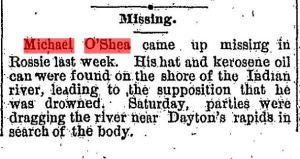 I was aware of Michael’s existence. He was an Irish immigrant and tailor in Upstate New York. I believe he is a close relative of my 3rd Great Grandfather, Patrick Shea or O’Shea and I know the men married sisters, Amy and Theresa McCumber, and the two couples were listed consecutively in the 1850 United States Census in Philadelphia, Jefferson County, New York. I had already found evidence that Michael and his wife were buried at St Patrick’s Cemetery in Rossie, New York (as was Patrick). But that was pretty much the total of my information prior to finding the newspapers.
Upon searching the NYS Historic Newspapers, I learned that Michael stopped by the hotel of George McLear in Rossie for drinks twice on the 21st of April 1886 and then while walking home that night fell into the Indian River. He was first reported missing but his body washed ashore days later.
 In response, his widow, Amy, filed a civil suit against the hotel owner for serving Michael. The story plays out in articles in a number of the region’s newspapers in two counties as the case was tried, overturned and pursued again later by Michael’s daughter Rosanna. Ultimately the O’Shea’s lost the case when the defense persuaded the jury that Michael wasn’t that drunk and it had been a very dark night to be out walking without a lantern and it was likely just an accident.
His history of drinking didn’t serve the family well either as the defendant in the first trial remarked, “his death was no loss to the plaintiff as he was a worthless fellow and did nothing to support his wife.”
Ouch!
Happy hunting,
Jess
August 25, 2015
So as I noted, I’ve been working on a presentation on black sheep ancestors—which I’ve found a fair number of hanging out on my family tree. Some I’ve found by accident, some I obviously went looking for—like good old H.R. I’m going to write about a few of the side characters in my presentation because of their interesting stories and the great resources I found to research them.
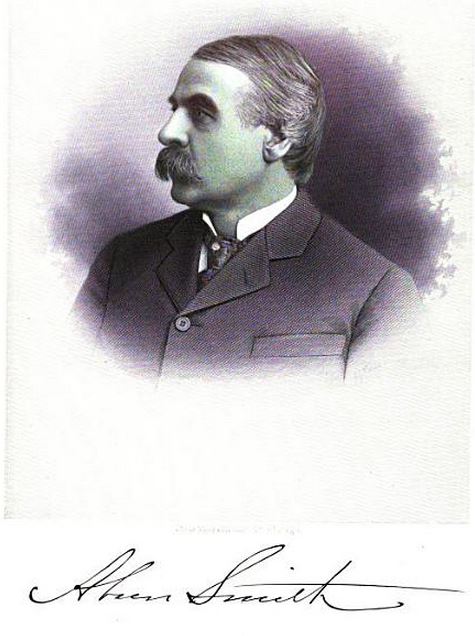
 I was trying to be better about following out the siblings of my direct ancestors and researching the siblings of Hugh and Jane Alison Massy starting with Rowland Hill and Elizabeth Massy Alison (because siblings marrying siblings). I’d hoped the double family tie might lead me to more information on my Massy-Alison family. But while the Rowland Alison family did move briefly to Detroit and it appears Jane and family followed along right after Hugh’s death, Rowland and family quickly moved on to Chicago where they settled and the research hasn’t yet led me to further revelations on my direct line. But it did lead to a few interesting characters like Abner Smith.
Rowland had at least 5 children including Edith who married Charles Lee Caswell in 1870. The couple had two children including Charles Lee Junior who studied at Northwestern University Law School and was admitted to the Bar by the Supreme Court of the State of Illinois on 1896. He worked in practical law in Chicago until he made junior partner in the firm Smith & Caswell with Judge Abner Smith upon the Judge’s retirement from the Circuit Court Bench in 1903. Smith and Caswell can each be found among the turn of the century who’s who for Chicago prior to the fall of 1905 when Abner became the president of Bank of America and Caswell appears to have gone on to found Caswell & Healy.
 By April the following year Smith and several others were indicted for conspiracy leading to the wreck of the bank. Among those who lost the majority of their investments was Clarence Darrow who paid out of pocket to all small depositors and served with his partner Edgar Lee Masters (Spoon River Anthology) as attorney for the receiver, Daniel Healy, at Abner’s hearings. There are great detailed write ups in the Chicago Tribune Archives—like this one, “Smith Plea Met by New Charges”. Abner tried every appeal possible before turning himself in to the Cook County Jail for transport to the State Penitentiary in Joliet, Illinois in May of 1909. And then the process was lengthened when the Sheriff actually refused to transport him.
 In the end he served a year and a month, and on parole in July of 1910 returned home to Chicago and practicing law. His wife Ada died in 1914, he was enumerated as a widowed lodger in 1920, and when the census came round again in 1930 he had married his former partner’s widowed mother, Mrs. Edith Alison Caswell—Rowland’s daughter and my 1st cousin 5 times removed. Abner died in 1932 at the age of 89 and Edith died a year later.
One of my biggest finds from this side trip is that the Tribune archives are fabulous for researching the notable and infamous—especially if you have Chicago roots. And as cases get messy enough you may be able to continue your research in legal reviews or biographies of notable lawyers.
For example, Reports of Cases at Common Law and in Chancery Argued and Determined in the Supreme Court of the State of Illinois Vol 239 (available in Google Books) has a detailed and verbose review of the case which charged that the defendants wrongfully, wickedly, fraudulently, feloniously and unlawfully conspired, combined, and confederated… to cheat and defraud and injure the public…” and that’s leaving out a ton.
Happy hunting,
Jessica
August 22, 2015
Working out of order… June included a day trip to ACPL’s Genealogy Center with the Lansing Area African American Genealogical Society. It was a different perspective. I was attending more as a consultant to help the group if they needed than to focus on my own research, so I spent a bit more time keeping an eye out for my fellow researchers then I tend to. Even still it was my first experience of trying to do that trip and get anything done in what amounted to an afternoon. It will never be my first choice! But if you have to, plan ahead.
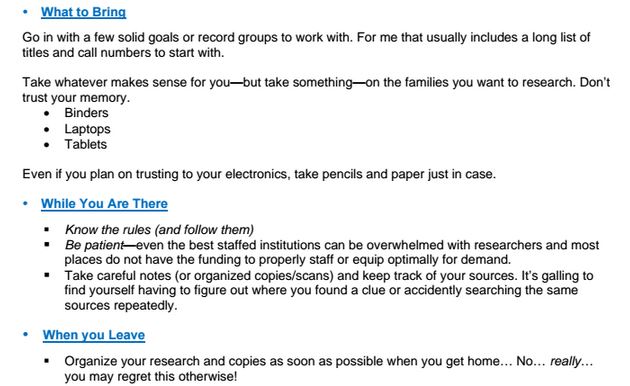
 I gave the group homework when they decided to make this their summer trip—links to The Genealogy Center’s website and catalog, instructions to use PERSI, and the basics I pass on in any of my talks that include planning for roadtrips.
That last on has bitten me more times than I care to admit (example)… but I am infinitely better than I was.
I went in to the day with the idea that I would track down a number of articles on the Hampton’s and their Allied families that traveled together from North Carolina to Arkansas in the early 1800s. I am more and more convinced that the answer to some of my slave brick walls will be found in researching these slave-owning families. Nothing definite as yet but I have a lot of leads to rundown that might help me connect to a few DNA matches.
Happy hunting,
Jess
August 20, 2015
So the summer has been a bit overwhelming and I am embarrassed to say I missed my own blog anniversary… but I’m back!
I’ve spent a lot of the summer jumping around in my research. And I’ll be covering a few of my experiences in the next few posts but first and foremost I’d like to give a very late shout out regarding the annual Abrams Foundation Family History Seminar hosted by the Archives of Michigan and the Michigan Genealogical Council last month. For those not in the know, it’s an annual Friday-Saturday event in July featuring great speakers—generally one nationally recognized presenter (this year, Michael Lacopo) and a number of regional presenters—and a Lock-In at the Archives on Friday evening.
Jill Arnold’s session on World War I records at the Archives of Michigan was my Friday highlight. It was a great rundown of the collections suggested in a new research guide available at the Archives. It gave me a lot of ideas for researching my Shea uncles and cousin who served. My great grandfather was turned away from serving when they realized he had TB but he had three brothers and one cousin serve out of Michigan.
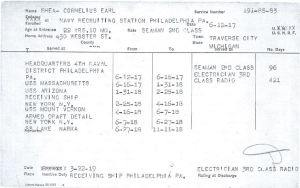 I was able to immediately follow up by using my time at the Lock-in to pull cards in the Veterans’ Bonus Files for Uncles Earl, George, Glen, and Cousin Roy Shea. I was particularly fascinated by the Navy cards which listed each posting (ship or base) where my uncles Glen and Earl were stationed including enrolling a day apart in Philadelphia and each serving their first 6 months together on the U.S.S. Massachusetts before splitting up. They served throughout the war leaving the service in March of 1919 having attained the same rank of Electrician 3rd Class Radio.
I was actually able to go back to work the next week and follow up with the book U. S. Warships of World War I by Paul H. Silverstone (available at the Archives) which offers pictures of either actual ships or a sample of their class along with statistics and information. It’s a nice piece of color to add to your understanding of your ancestors and those times.
My Saturday highlight was Michael Lacopo’s presentation “Deconstructing Your Family Tree,” which has undoubtedly become a very popular and needed theme of late. Lacopo reminded us that there are any number of errors within our research or others’—sometimes innocent, sometimes intentional—and we need to effectively evaluate sources getting back to original documents, tracking down the sources of published genealogies, and being mindful of why a document was created in the first place. The line that stayed with me, “If you’re going to give yourself a concussion do it properly,” by banging your head against the correct brick wall versus someone else’s.
In the two days I also attended sessions on genetic genealogy, using Facebook groups for genealogy research, and Michael Lacopo’s presentation on records between the Census. And I presented on my black sheep ancestors (such as Henry Massy)—from my point of view you have to find the humor in the situations and remember their actions shouldn’t reflect on current generations.
I am fairly certain a good time was had by all. It definitely worked that way for me!
Happy hunting,
Jess

 Genie Road Trip