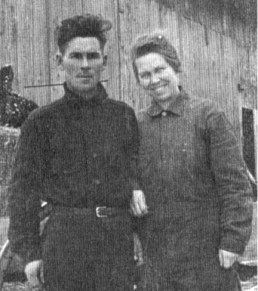
Character Studies


Maud G. Cory was my 4th Great Aunt and the sister of Augusta Cory Massy—but she was also only three years older than her niece (and my 3rd Great Grandmother), Flora Jane both discussed in this post. So, for the longest time I thought that it was possible that the pair of them could have ended up together when Augusta died. Unfortunately, I’d pretty much come to the conclusion that this was not the case, which meant I was searching for Maud and her mother Nancy Jane Cory who seemed to disappear after the 1870 Census.

Anyway, I had a bit of free time on my hands this past week and had the chance to run a few searches that I haven’t tried in a while. I badly need a good checklist for each of my ancestors and which places I’ve checked for them and when—but I knew that I hadn’t tried searching for Maud in the updated FamilySearch.org. So I gave that a try… And I believe I have found their trail.

I found two marriage records indexed for a Maud Cory born in Plymouth, Michigan and the daughter of John B. Cory and N. J. Foster (with the correct birth year) living in Harrison County, Iowa. The only new bit of information here was the last name Foster for her mother—who is at times listed as Nancy, Jane, and Jennie N. Well… that and Iowa. Iowa is a whole new world in researching my family.

Anyway, the first marriage was to George Kenney in 1880 and the second was with J. A. Wolcott in 1885 and she was listed as a widow. After these I also found an 1880 Census listing for Jennie N. and Maud Cory in Harrison County and I know that there are Kenney’s and Wolott’s in that county to sift through…

But that’s as close as I’ve gotten. I couldn’t find her in 1900 Census and of course the Census-that-would-fix-everything—the 1890—no longer exists. But I have a long list of other places to check online and a new list of resources to check at LOM and ACPL on my next trips.

I’ll keep you updated!

Happy Hunting,

Jessica

Dr. Charles Morrill and Sarah (Skiff) HoldenToday’s the 191st anniversary of Dr. Holden’s birth and seemed a fitting time to introduce my Holden family.

The first of my Holdens to settle in Kent Co., Michigan were my 4th Great Grandfather Dr. Charles Morrill Holden and his family. Dr. Holden, his wife Sarah Ann (Skiff), and eleven of their children settled in Courtland Township where, Dr. Holden practiced medicine and farmed. When I was started researching this line I was interested in Dr. Holden’s role as one of the pioneer doctors in Kent County but, to be honest, I was more fascinated by the names of his children.

Charles and Sarah are common enough names and maybe their children’s names are a strange reaction to that. I knew going in that my 3rd Great Grandfather’s name was Chapin—which didn’t seem common for the time but was at least a name I was familiar—but then I was introduced to the rest of his siblings.

  1. Cassius—Died young.
  2. Catherine—Unknown.
  3. Americus G.—He died after being sent home from Union Army due to illness.
  4. Horatio Seward—Became a doctor in Pierson and Grand Rapids, Michigan.
  5. Chapin B.—Married my 3rd Great Grandmother Lois Blakeslee.
  6. Rosalia D. —Died young.
  7. Xantippe—Married Edd P. Nelson.
  8. Cassini J.—Married Flora Lewis.
  9. Ida—Married William Pitts.
  10. Nellie—Unknown.
  11. Saracence—Married Frank D. Saunders.
  12. Kendric Charles—Married my 4th Great Aunt Minnie Isabel Porter (George’s sister).

I don’t know the what the middle initials stand for where I have them listed—though I could swear that I saw Balean as Chapin’s middle name somewhere, sometime before I learned to accurately cite my sources. My favorites have always been Xantippe (pronounced with a Z) and Saracence (totally guessing here: Sarah-sense). I know the latter is mostly noted as Sara in articles and family notes. I love names!

A copy of this photo is held by the Rockford Area Historical Society Museum, Rockford, MI.

Happy hunting,

Jessica

One interesting character I found through cluster research is Rockford Area Poet, Julia Ann Davis Moore—and incidentally, it’s her birthday. Julia and my 4th great aunt Louisa Morningstar married brothers Frederick and John Moore. And Louisa’s brother, William H. Morningstar, married Julia’s sister Viola. And her niece married into my Holden family. Julia was a quaint country poet who chronicled the precarious ups and downs of life in the 1870’s through lyrical verse. For decades she was scorned, even inspiring a poetry contest for awesomely bad verse, but in the last twenty years there has been a renewed interest in her work for its historic value. Regardless of your taste in poetry—though I have found far worse—her work spotlighted the concerns of the citizens of Algoma Township, Kent County, Michigan. She’s particularly noted for her poetic obituaries which include verses on members of my family.  The following was is about a 3rd cousin (4 times removed).

Hiram Helsel

Air — “Three Grains of Corn”

Once was a boy, age fifteen years,
Hiram Helsel was his name,
And he was sick two years or so;
He has left this world of pain;
His friends they miss this lovely boy,
That was patient, kind and brave.
He left them all for him to mourn —
He is sleeping in his grave.

He was a small boy of his age,
When he was five years or so
Was shocked by lightning while to play
And it caused him not to grow,
He was called little Hi. Helsel
By all friends that knew him well —
His life was sad, as you shall hear,
And the truth to you I’ll tell.

His parents parted when he was small,
And both are married again.
How sad it was for them to meet
And view his last remains.
He was living with his father then,
As many a friend can tell;
‘Tis said his father’s second wife
That she did not use him well.

Just before little Hiram died —
His uncle and aunt were there —
He kissed them both — bid them farewell,
They left him with a prayer.
Now he is gone, Oh! let him rest;
His soul has found a haven,
For grief and woe ne’er enters there,
In that place called heaven.

For more of Julia A. Moore’s work check out Mortal Refrains: The Complete Collected Poetry, Prose, and Songs of Julia A. Moore, Sweet Singer of Michigan edited by Thomas J. Riedlinger.

Happy Hunting,

Jess

On my last trip to Ft. Wayne I was researching back from my 3rd great grandmother Amelia Grove and discovered I was a little more German than I thought. But what progress I made on the Grove, Dice, Besore and Koppenhaver families really came from my experiences researching my Morningstar and Helsel lines—also from Ohio and Pennsylvania.

I am a huge advocate for cluster genealogy. You learn so many fascinating details about your ancestors by learning about the people who travelled with them and lived in their vicinity. And I have found a ton of relatives and great stories by following those, at first glance, unrelated families. My Morningstar line is a great example of this.

The first Morningstar I came across was also a 3rd great grandmother, Sarah Elizabeth Morningstar, who married George Erwin Porter. Now the Porters of Rockford, Michigan have been well researched over the years and when I first started doing research at the Rockford Historical Museum (which has an excellent collection of genealogical and historical material) a Porter relative was working as a volunteer. So, when he knew what I was researching he gave me pictures, a detailed article and some ideas of where he thought it might be wrong. The article included the names of Sarah’s parents, Jacob and Mary Morningstar.

Now, Jacob and Mary weren’t terribly hard to track. The family had settled in Algoma Township in Kent County, Michigan in the 1840s having come to the state with a large cluster of families including the Helsels, Hull, Christy, and McFall families. At the time I truly didn’t get the significance of the group moving together or the concept of cluster genealogy but when I started to try and figure out who Mary Morningstar’s parents things got complicated. Jacob had died relatively young and by going through the census from 1850 to 1900, I was able to figure out that Mary had remarried a German-born immigrant by the name of Lewis Whitebread. Also at about the same time I was able to get Sarah’s death certificate which listed her mother’s maiden name as Helsel, so I had Mary Helsel Morningstar Whitebread. And in the 1870 Census her widowed mother, Elizabeth Helsel, was living with the Whitebread family.

Unfortunately, there were two widowed Elizabeth Helsels in the township and, since Mary was married already in 1850, I didn’t know which family she belonged to. I ended up following all the Helsel children to try and find the connection—and while I was at it I worked on all the Morningstars as well—and slowly but surely I was able to chart a web of interconnected families. We were related, at least by marriage, to all the Ohio families listed above plus a few I hadn’t realized had also moved with the crowd. And by being forced to track families through the Census, County Histories, and any other source I was able to find, I was able to figure out which Helsel I descend from—John as opposed to his brother, Jacob, I found fun and bizarre connections in Kent County I never would have noticed, and having all those connections helped me in moving back to Ohio and Pennsylvania to the Morgenstern and Holtzel families.

Lesson learned… Follow out all siblings lines as well as your direct ancestors and definitely look into the families they travel with… there’s often a solid connection and your research will be the richer for it.

Happy Hunting,

Jess

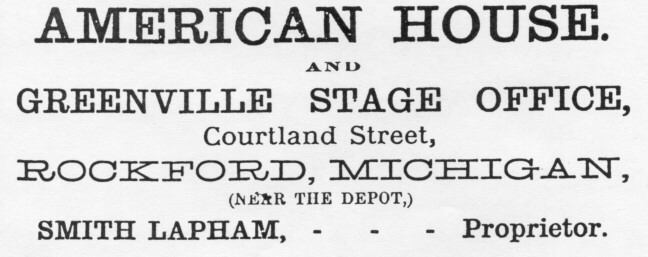
Earlier this week I had a lovely conversation with a retired co-worker who has taken on a newspaper indexing project and she expressed how much she has enjoyed reading the detailed and fascinating articles that went into old weekly newspapers—from local gossip, to thoughtful discussions of current events, to poetry. I have had similar experiences over the years pouring over the oldest editions of The Rockford Register, held at the Krause Memorial Library in Rockford, Michigan. And while many of my family members have had important moments covered in The Register, none made such amazing use or were followed so closely as the Lapham family, credited as pioneers of Rockford (once Laphamville).

My co-worker, I think, was surprised by the poetry which is so very different from our modern sense of newspapers but the Lapham’s took time out for poetry and prose. Their contributions included a very long poem from the occasion of my 5th Great Grandparent’s (Smith and Katherine Lapham’s) Golden Wedding Anniversary by Smith, a tear-jerker on the death of one of their grandchildren at the age of 12 by her father (their youngest son, Judge Embree B. Lapham), or this short poem on the occasion of Embree’s 83rd Birthday:

Our Birthdays—My Eighty-third

Our birthdays come and quickly go
Exactly on the date.
We’re on year older—this we know
‘Tis ordered so by fate.

Time lingers not for youth or age
Nor does it favor me.
I turn and scan another page
To find I’m eighty-three.

Life’s river flows with restless face
On toward the unknown sea
Where all must end their earthly race
And make Heaven their plea.

If we can show our record clear
Or nearly free from flaws
There’s nothing then we need to fear.
For Christ will plead our cause.

He’ll say to us you’re welcome here,
You’ve done your very best
So banish every doubt and fear—
You’ve gained eternal rest.

Printed in the Rockford Register 23 March 1933. Judge Embree B. Lapham ran a confectionary, managed hotels, was co-creator and served as editor of The Belding Banner, among other endeavors. He also served as Mayor of Belding and served for more than 25 years consecutively as Justice of the Peace for Rockford, Kalkaska, and Belding—with two of those positions held simultaneously. He was born in 1850 and lived to the ripe old age of 94.

The photograph was printed in the Belding Banner on the occasion of his death in 1944.

It’s Banned Books Week and the freedom to read is something I feel very strongly about. It is also something I now strongly associate with a particular portion of my family.

I am very proud and thankful to be part of a relatively close-knit set of readers in my family—including my Gran, Mother, Aunt, and Cousin—and I think a rather telling illustration of us (and most of the women in our family) is one that comes from our association with books. We love them! We carry around stacks of them. We find it hard not to stop in bookstores. We love our libraries. We just LOVE books! And we love sharing them, hearing about them, talking about them… So, imagine our reaction when we started hearing about this highly touted and increasingly maligned children’s series from Britain in the late 90s and early Aughts.

J. K. Rowling’s Harry Potter series probably would have gone totally unnoticed by us. We were all pretty much beyond reading books for that age group. But then the news stories started with parents up in arms over the exploits of a tween wizard and his friends. Really? Then came the sermons, challenges, and outright burnings—so much energy for a book that was already an international bestseller. It all got our attention.

So, what was our group of educated and responsible readers to do?

Read them, of course! There had to be something good there. We are a fine crowd of contrary women. Do not tell us what we should not read—it only infuriates and intrigues us. We are an example of what Ralph Waldo Emerson meant when he commented, “Every burned book enlightens the world.” We read them, re-read them, and shared them with others.

 For more information on Banned Books Week check out the American Library Association’s site: http://bit.ly/ntsy9P or Banned Books Week: http://bit.ly/o5dS6h

Cheers,

Jess

I’ve been thinking a great deal about my great grandfather, Robert James Shea, and his family lately. I’m not sure if it’s because I’ve been going through my files and photos—I probably have more from the Packers and Sheas than any other branch of my family—or because I decided to inventory my postcard collection which includes a stack related to the Michigan State Sanatorium in Howell, Michigan where he was treated for Tuberculosis and met my great grandmother as a fellow patient. Or maybe it’s because I’ll have a chance to pass through that part of Michigan where he was born in the Leelanau Peninsula next week. Regardless of the reason, Robert Shea is on my mind.

He was born 25 Jan 1888 in Empire Township to Cornelius and Ellen (Cunningham) Shea, the first of their nine children. He was listed as a farm laborer in the 1910 Census but by 1920 he had been admitted to the State Sanatorium. He met my great grandmother, Cora Helena Packer, there and they were married in Grand Rapids in 1922. Their first two children were born there—my Grandmother, Ethel, and her younger sister, June. In the 1930 Census Robert was working in an upholstery shop and the family lived in Tallmadge, Ottawa County. In 1931 their last child Robert Arthur was born. In April of 1933 Robert finally succumbed to complications from his Tuberculosis at Kalamazoo State Hospital.
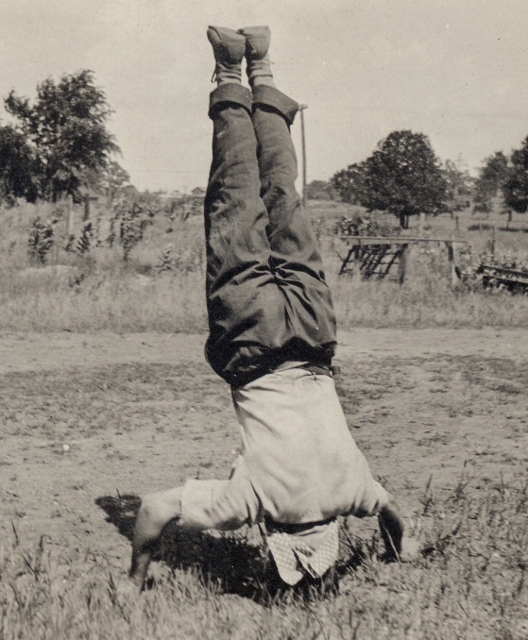
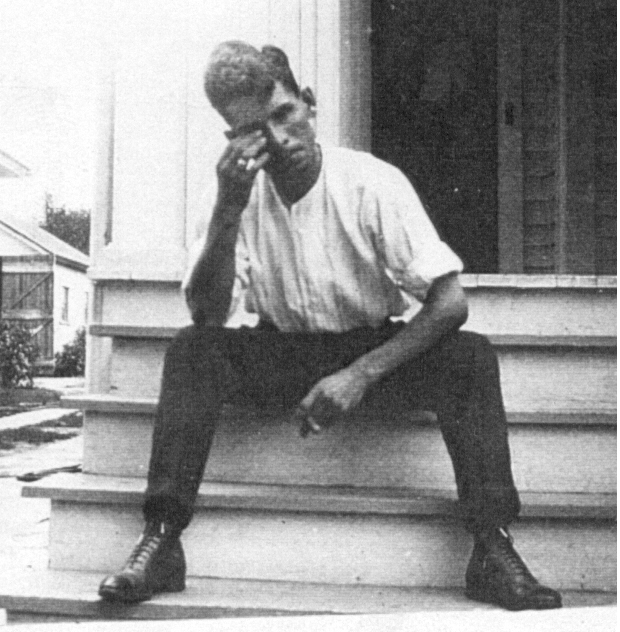
He’s a character I really only know from pictures and the stories my Grandmother and Great Aunt share—and Gran was only 8 when he died. In every picture is a dark, thick head of hair that seems often unruly. The more unruly shots make me think of Lyle Lovett (I’m a big fan). And he had a darker complexion—an olive undertone—that he passed on to Gran and likely her three children. It’s a running joke that they all tan darker than me.

He didn’t have an easy life. The idea that he likely had a lung removed as part of his TB treatment but was still working as a lumberjack before he died has always struck me as sad. But the photo evidence suggests he was able to have fun and find joy in the times that he had.

As with all my other lines, I am always searching to add more depth to that disjointed list of facts, so I plan to continue my research on Robert (and Cora) by looking into the history and records held by the State Archives on the Michigan State Sanatorium at Howell and the Howell Carnegie District Library. I’m quite curious about what their routine would have been like especially since they were patients when the “fresh air cure” was a popular approach to TB treatment.

For more information on The Michigan State Sanatoria check out this great 2009 article from SeekingMichigan.org: A Healing Place.

All photos are from the collection of my Grandmother and Great Aunt.

This is just a quick post between packing and prep before I head out for FGS2011.

Tomorrow is Labor Day and that along with a lot of discussion on the GeneaBloggers sites (including GeneaBloggers Radio Episode 33) inspired me to look back through my family research at the jobs various family members have held. And while there have been many unique ones (such as saxophone maker, reflexologist, and tailor) I decided to focus on how my family has played their own role in the building of Michigan.

My maternal 5th great grandfather, Smith Lapham, was a pioneer, moving into the state after working on the Erie Canal, and eventuallyheading up the Grand and Rogue River until he settled in Kent County, there becoming a farmer and entrepreneur in a little town originally known as Laphamville, as well as serving as a State Senator in 1858.

My maternal great grandfather, Cornelius Shea, I believe moved in the 1880s from Upstate New York to Michigan with a few of his brothers to work in and around the lumber camps in Leelanau County, Michigan, then later moved down to Grand Rapids to work in the Furniture industry.

And finally, my paternal grandfather, Levie Trotter, was part of the Motor City, moving his young family from Arkansas to Detroit in 1951, and working for Chrysler Corporation for 32 years.

This is a small sampling of the generations of hard workers that I can claim as family—each very different but each part of an important time in Michigan’s economic development. And likely you’ll hear more details about all of them in blogs to come.

Happy Labor Day!

Jess

So Henry R. Massy dropped off the radar in 1869-70, as far as I could tell. But I was slowly able to expand what I knew about him before then–including finding out he was a replacement soldier in the Civil War. My only thought to move forward was to try following that lead. I found Henry Massy who served for the Michigan Infantry Civil War in a pension index now living at the time in Latham, Logan Co, Illinois and requested his pension record.

I was blown away when the packet arrived. True to form everything was complicated for Henry. There was an extensive back and forth in the file because he was forced to prove his identity. He had changed his name to Harry or Henry (he used both) R. Allison and remarried a widow named Nancy Stinnett in 1876. In the pension he describes his police service, but claims he was never previously married and had no heirs. His pension request was approved with a special note about the way he signed his middle initial “R.” And that’s exactly what helped me to solidify the connections. He signed his oath to the police force, and he signed his enlistment and pension paperwork with the same funny “R.”

As an additional note, I was playing around on Ancestry on a day after they started picking up more scanned newspapers and looked for obituaries in the Logan Co. area for H. R. or Nancy and I came across a number of articles. One featured a Harry Allison and friend who went into Decatur and were charged with drunkenness, fined and asked to leave town. I don’t know if it’s really him. There was one other Harry in the county. But given other things I’ve seen… It’s certainly possible.

Decatur Herald, 3 January 1908

So, now I hope to find some time to slip away from FGS and swing back up to the Logan County Genealogical & Historical Society’s research room to see if I can round out any more of Henry’s story, as well as over to Lake Bank Cemetery to photograph Harry and Nancy’s headstones.

Happy Hunting,

Jess

I’m attending my first FGS Conference this year in Springfield, IL. I chickened out on the one in Arkansas a couple of years ago when it would have given me the impetus I needed to get down to Bradley County and do research—and I regret it. So this year, when I’ll be 45 minutes tops from Logan County, IL—the later stomping grounds of my most untrustworthy and probably most fascinating ancestor—I couldn’t pass it up. So, now I’m making lists—stuff to pack, finding directions, and trying to decide the best way to sneak off and experience a little bit of Harry R. Alison’s Logan County.

But you need to know a little about Harry … back when he was Henry.

He was an Irish cop in DetroitThat’s the only lead my grandmother, Ethel, and her sister, June, could give me in my quest to find their great-grandfather. Their grandmother, Flora Jane (Massey) Packer, shared very little about her parents—and possibly knew very little. They said an aunt and uncle had raised Flora when her mother died and passed on little information—about her father in particular. She knew he was an Irish policeman in Detroit for a time but beyond that her questions weren’t answered. Aunt June suspected that there was more to the story and I had been trying to figure out what that was for 10 years.

To begin with, Flora’s death certificate lists her as the daughter of  Henry Massey and Augusta Cory… and for the longest time searching for the pair through census indexes the closest I could find was John O. Massey, a policeman in Detroit. Eventually—as online indexes improved—I  found Augusta and Flora living in Detroit with Augusta’s parents John B. and Nancy Cory in 1870… but no Henry.

However from there I was able to gather a great deal of information. I started looking at Detroit Directories and found Henry and John O. Massy listed as policeman and as I worked backwards I could place them in the same residence. I also found a transcription of Henry and Augusta’s marriage license from 14 Aug 1866 and while I have been unable to locate an existent copy of Flora’s birth certificate, she lists her birth date as 14 Jan 1867. Given the state of healthcare at the time, I would argue that Augusta was about 4 months pregnant at the time of their wedding.

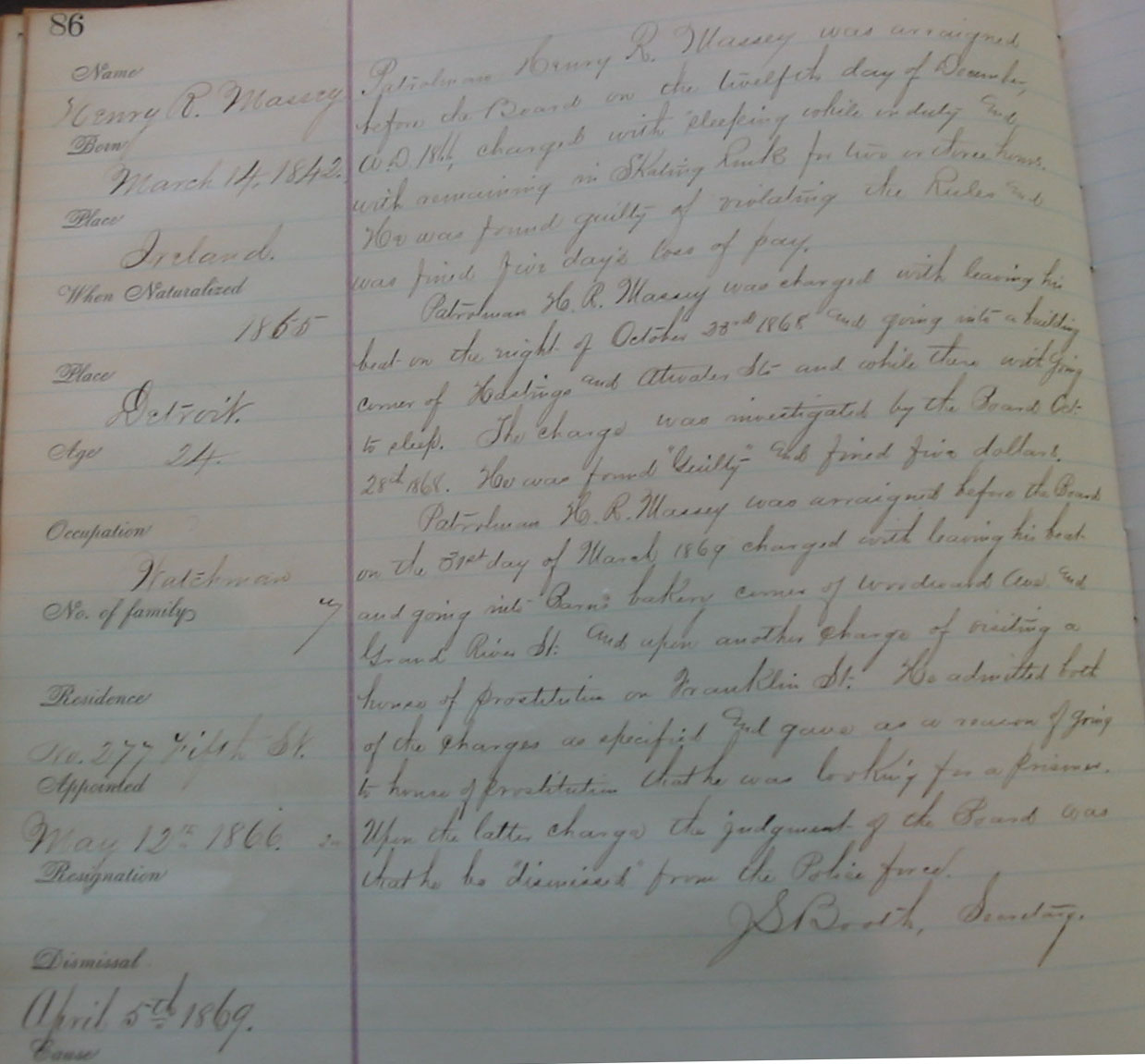
Patrolman H. R. MasseyIn addition I pulled up HeritageQuest and searched Persi for anything on the Police in Wayne County, Michigan. I was thrilled to find a Detroit Society for Genealogical Research Magazine transcription from the Applications to Detroit Police Department, 1865-1871. I found John O. Massy’s application. It included when he applied and how he was honorably discharged much like every other applicant. And then there was Henry’s. It was unlike any other… his had notes:

  • Patrolman Henry R. Massey was arraigned before the Board on the twelfth day of December A. D. 1866, charged with “sleeping while on duty and with remaining in Skating Rink for two or three hours. He was found guilty of violating the Rules and was fined five day’s loss of pay. [no endquote in original]
  • Patrolman H. R. Massey was charged with leaving his beat on the night of October 28th 1868 and going into a building corner of Hastings and Atwater Sts and while there with going to sleep. The charge was investigated by the Board Oct 28th 1868. He was found “Guilty” and fined five dollars.
  • Patrolman H. R. Massey was arraigned before the Board on the 31st day of March 1869 charged with leaving his beat and going into Burn’s bakery corner of Woodward Ave. and Grand River St. and upon another charge of visiting a house of prostitution on Franklin St. He admitted both of the charges as specified and gave as a reason of going to the house of prostitution that he was looking for a prisoner. Upon the latter charge the judgment of the Board was that he be dismissed from the Police Force. J. S. Booth, Secretary.

Dismissed in 1869 and gone in 1870.

The original book of applications is housed at The Burton Historical Collection at the Main Library of Detroit Public Library.

More later,

Jess

« Previous Page