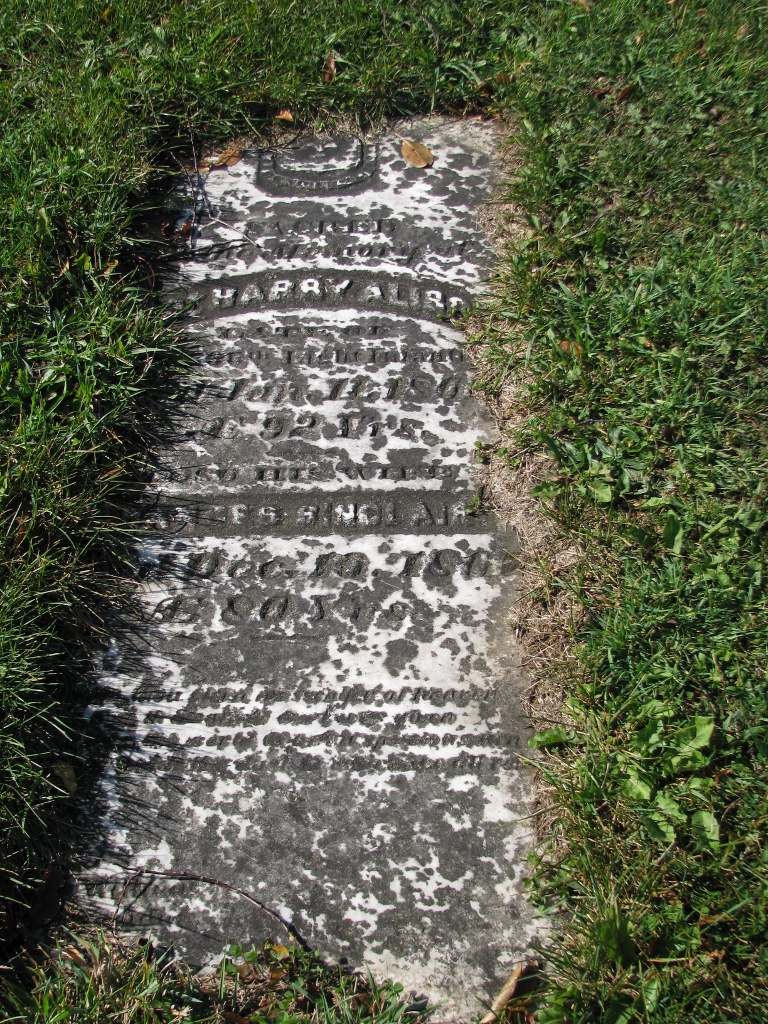
Gravestone of Captain Harry Alison and Frances SInclair Alison, St. Paul's Cemetery, Warwick Township, Lambton County, Ontario, CanadaSince I omitted it from my post on the first day of our roadtrip, this is the tombstone of Captain Harry Alison, patriarch of the Alison family and the unofficially named Captain’s Alison’s Settlement which sprung up around his lots in Warwick Township of Lambton Co, Ontario in the 183os.

Harry was born in Perth in 1775 and when his father died young he was sponsored by an uncle who sent him to St. Andrews with plans for him to become a solicitor. But, unhappy with the profession, he left service at the end of his requisite period and relocated to London with plans to join the Army. With the aid of a well-placed relative he was given and ensigncy in the 93rd Highlanders. When the 90th Highlanders were reformed under, Major Rowland Hill, Harry came on as Paymaster and served for near 30 years.

In that time he married Francis Sinclair and had a family of nine born all over the world, including Ireland, the West Indies, France, and the Ionian Islands.

He bought out around 1830 and petitioned the Crown for land in Upper Canada (Ontario), and eventually established the family in Warwick Township.

His children were:

  • Jane Alison who married Lieutenant Hugh Massy of the 90th and 33rd Regiments (my 4th Great Grandparents)
  • Rowland Hill Alison who moved his family to Detroit and then ultimately settled in Chicago
  • Charles Alison who served as “Her Majesty’s Envoy Extraordinary and Minister Plenipotentiary to the Shah of Persia”
  • Brisbain—who became a sailor in Ontario despite likely deserting the British Navy
  • Frances Mary who married Thomas Wade Rothwell, the son of Brevet Major Wade Rothwell.
  • Jullia Dixon who married Robert Armon Hill retired from the 5th Regiment
  • Ann McNair who married William W. Nichols
  • Mary H. who married William R. MacDonald
  • Peter John Alison who married Frances Delia Travers

Harry served as a Justice of the Peace for nearly 25 years. He died in North Duoro where he spent the last few years of his life as part of the household of his son-in-law William W. Nichols. He was buried in St. Paul’s Cemetery.

The marker reads:

In Memory of Captain Harry Alison, late of H. M. 90th Light infantry. Died January 11, 1866 ae 92 years. Also his wife Francis Sinclair died December 16, 1867 ae 80 years.

Happy hunting!

Jess

A long obituary on Harry posted in The Volunteer Review and Military and Naval Gazette (Ottawa, Canada, Monday, 11 Feb 1867) and in the The Peterborough Review around the same time. Also, the Crown Land Petitions and British Regimental Histories add more information on Harry’s military career.

As I mentioned yesterday, part of this trip was inspired by the detailed footnotes in Eleanor Neilsen’s The Egremont Road which has a lovely section on the Alisons and their allied families. And one of the main sources she pointed to was a memoir created by Peter John Alison, Harry’s youngest child, which is held at the Western Archives at Western University in London, Ontario. So, another one of our stops was in London so that I could look at the manuscript as well as an Alison photo album that I found in their catalogue when I was searching for the memoir.

The Archives is located in the D. B. Weldon Library on campus and getting to it was a little trickier that I thought it would be. But when you reach the building it’s huge and, at least for the day I was there, it was consistently packed. Luckily, the Archives are tucked into the back corner of a large Main Floor and you feel miles away from anyone when you’re tucked into the cozy reading room and working.

It’s suggested that you contact the Archives ahead of time for materials that they need to pull from storage (as pulls are only done three times a day) so I had struck up a conversation with one of their staff by email and both boxes were pretty much waiting for me on arrival. I settled in and spent most of the day on Peter’s memoir which, according to the top page was created to satisfy a persistent cousin to whom he remarks:

You have asked me so often to write you an account of my early days in the back woods of Ontario, Canada, that I think I will have to do as the Unjust Judge did with the widow – Grant your request to get rid of you.

The document gives a rough background to the family but it is full of interesting tidbits about his parents and siblings through the eyes of the baby of the family (he was six at the time of their move to Canada). He didn’t display a lot of respect for his elder brothers whom he felt were no help to their father in the initial establishment of their households in Warwick commenting:

My eldest brother had been in the Army with my father’s regiment, and my next brother had been in the Navy, they were not fitted for the bush life at all. It was pitiful to see them using an axe, the one most useful tool of those early days. They would chop around a tree like a beaver, then of course, they would not know which way the tree was going to fall, except it had decided leaning in one direction.

But he did admire his sisters (at least in retrospect) and their accomplishments:

My sisters were all highly accomplished for my mother had them taught by the best French and English masters, it was delightful to hear them play and sing to the piano, harp and guitar, and they spoke Greek and Italian as well as they could English.

In the memoir he shares his memories of his sisters Frances and Julia’s courtships (with Thomas Rothwell and Robert Hill respectively) in detail and humorously.

The manuscript by itself was worth the trip but the other item I had pulled turned out to be a photo album given to Frances (Travers) Alison, Peter John’s wife, in February of 1880. Very few of the pictures are labeled but among the ones that are is a picture of Peter’s brother, Brisbain. I would love to be able to identify more of the images through my research but we’ll see how that works out.

The staff at the archives were very helpful and a pleasure to work with!

Happy hunting,

Jess

Updated: 9:26 am with a better image. jt

I spent the past week road-tripping across Western Ontario in search of my maternal grandmother’s roots and this is the first of a series of related posts talking about that trip.

So my intrepid crew (Mom & and Gran) and I started our journey on a sunny Sunday morning with the a plan to drive into Canada via the Blue Water Bridge and take the 402 into North West Lambton County swinging North around Warwick and driving down the Egremont Road, one of the earliest in the area built by and for the Irish and British emigrants in the 1830s.

Gran’s family, led by my 5th Great Grandfather Captain Harry Alison, came to Canada in 1832 after Harry and his eldest son Rowland Hill Alison each sold out of the British Army. Both served with the 90th Regiment Light Infantry (the Perthshire Volunteers) along with Lieutenant Hugh Massy who married Harry’s eldest daughter Jane Alison (my 4th Great Grandparents).  Harry parked his family in Ancaster, near Hamilton, Ontario, while he, Rowland, and his next son, Brisbane, scouted out a lot in Warwick Township. They settled on the highest lots along the Main Road just inside the Middlesex County border exactly midway between Sarnia and London. The settlement that sprang up around them became unofficially known as Captain Alison’s settlement.

The one site that I knew still existed is St. Paul’s Anglican Church on the Southeast corner of Egremont and Wisbeach Road where Harry, his wife, Francis Sinclair, and my 3rd Great Aunt Frederica (Massy) Rothwell were laid to rest. So that was where we made our first stop.

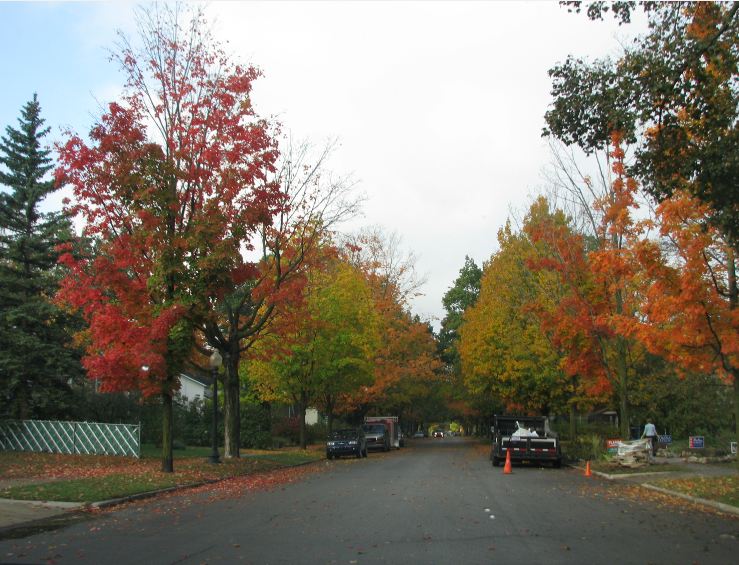
The little lot is picturesque. The plaque on the church reads 1856 to 1906. Harry’s grave stone is lying on the ground near the front door of the church. In the picture to the left (taken from the entrance) it is just in front and slightly to the right of the prominent tree in the background on the left.

For more information about the history of the Egremont Road and my inspiration for this leg of our journey, check out The Egremont Road: Historic Route From Lobo to Lake Huron by Eleanor Nielsen, published by the Lambton County Historical Society. It’s a fabulous read and meticulously footnoted with great primary materials that I otherwise would never have known existed.

More to come from Canada soon!

Happy hunting,

Jess

One of my non-travel experiences for Family History Month was my extensive prep for a genealogy for kids class to presented at work. I spent a lot of time collecting great resources and coming up with funny family stories, neat resources, artifacts they could get their hands on. I put together a “treasure box” of neat stuff—my great-grandmother’s locket that they let my grandmother use when she was teething, a variety of pictures, postcards, documents, and more. I created a high-graphic slideshow, I had craft ideas, and even resources for parents. I even tested ideas out on my oldest nephew.

The only thing I didn’t get … were attendees.

I was more than a bit disappointed. But we’ll try floating the program one more time in the summer and see what happens. In the meantime though, I found a lot of great resources that I think people need to check out. Here are a few of the websites I found interesting and helpful.

Have you seen other sites you liked?

Happy hunting,

Jess

We’re closing in on Halloween so here’s a blast from my past. My brother in I in 1982… clowning around.

Happy hunting!

Jess

This is the final resting place of my 5th Great Aunt (by marriage) and 1st cousin six times removed Julia Ann Helsel and her husband Henry L. Helsel. She was the daughter of my 6th Great Uncle Jacob Helsel and Elizabeth Shanks. She married her first cousin on May 15, 1845 in Portage, Ohio and the couple moved to Algoma Township, Kent County, Michigan to build their home. Julia had four children before her early death in October of 1854, 158 years ago this week. She is buried in Algoma Cemetery.

Happy hunting,

Jess

At the beginning of the month I took a peaceful road trip up to Leelanau and Grand Traverse Counties with my parents and my maternal grandmother and whenever we make the trip—usually to sight see and taste wine —I try to hijack a little bit of the trip for genealogical research.

In the past I’ve always been focused on the Shea’s who were involved in the lumber industry in the 1880s and 1890s in Leelanau. But this year I decided to step back and do a basic search in my database for other family members with ties to either of the two counties—because I know I get very focused sometimes and don’t recognize other connections to an area when it isn’t obvious. The search reminded me that my 2nd Great Grandfather also had ties to the area. I always think of the Johnson family as a solidly Kent County bunch, but at the time of the 1920 Census William Amos Johnson’s family lived in Traverse City where he worked as a plumber.

So, as part of our trip I stole an hour at Traverse Area District Library to look in their city directories in hopes of narrowing down the period in which the Johnson’s lived there, identifying where they lived, and also where he worked.

TADL has a nice collection of local Polk’s directories and William was listed in the 1919-1920 and the 1921-1922 books—first as a tinner and then as a plumber working for Arms & Cole Plumbers, Steam Fitters and Sheet Iron Workers on Cass St. The family lived at 859 Webster. The next day we drove through the neighborhood past the house and then on past his workplace. It was cool to add that snippet of their life to my collection of stories.

As an added bonus we also took a scenic drive from Glen Arbor to Muskegon before coming home which took us past roads traveled by the Shea’s and their allied families—Including Stormer Road  (named for a family two of the Shea brothers married into) and the village of Empire where my great grandfather was born.

Someday I’ll make it up solely for research, but my family has been great about letting me steal a little time out of their vacation for research.

Happy hunting,

Jess


One of this intrepid trio turns 35 today! Happy birthday to my slightly younger, but now hulking, younger cousin!

These are the three oldest Grandchildren of William and Ethel Johnson. I’m the middle child of the bunch by about 5 months. This was taken at my grandparents’ home on Main St in Rockford, Michigan (which backed up to the Rogue River) around about 1979 or 1980.

Happy hunting,

Jess

I love the detail in this stone—between the branch design and the square and compass symbol marking G. N. Shaw a Freemason—and the details in the picture with the tipping stones in the background.

This is the marker for the final resting place of George N. and Sarah (Johnson) Shaw in Rockford Cemetery, Rockford, Michigan.  George was the son of Sisson and Sophia (Rounds) Shaw. We’re not directly related but the Shaw family intertwines with most of the early Algoma Township families including the Helsels, Houses, Morningstars, and Rectors.

Happy hunting,

Jess

October is Family History Month and I am celebrating with a few genealogy-related road trips and workshops. So, ideally you’ll hear a bit more from me as the month goes on. But to start the recap…

Last year was the first time in years that I hadn’t been able to attend Western Michigan Genealogical Society’s Got Ancestors?! Workshop and I really missed it. I wasn’t going to pass up this year’s event. Workshops like this are reinvigorating, great for networking, and always useful in your research—even if you don’t  immediately hit the mother lode when you run home and try out the new site someone told you about.

So, I spent the start of the weekend in the Grand Rapids area for the two day event. This year’s featured speaker was Curt B. Witcher, Senior Manager for Special Collections at the Allen County Public Library in Fort Wayne, Indiana, whom I have met a number of times but I’d never heard him present.  I was delighted by Friday night’s session—a funny and practical presentation on strategies for successful internet research. Curt offered six great resources that researchers sometimes overlook—and I was thrilled to note that his list matched our top resources for our Free Genealogical Resources Online class at work.

Saturday’s first session on using ancestral origins reminded us to research the movements of ethnic groups for clues to your ancestors’ movements and circumstances. I came away with plans to find more information on Southern Migration. What caused my ancestors or their owners to move from North Carolina to Arkansas? Or Mississippi to Arkansas? For some reason I never thought of it quite that way despite definitely having done it with other lines.

Curt’s second session of the day was “Boot Camp and Roll Call” and it occurred to me pretty quickly that I hadn’t actually done any sessions on military records before. So, this was pretty informative to someone who has largely stumbled through or lucked into resources on her military relatives. He offered a number of great leads and reminded me that I haven’t done enough to track the military careers of some of my “uncles.” I’ve followed my direct line ancestors but I may find more leads by tracking their siblings and other close relatives.

The first afternoon session dealt with the non-Federal Population Schedule portions of the Census and left me very curious about what I find in the agriculture and business schedules relating to a number of my ancestors. In my notes there are a list of surnames beside each he described. I’ve used the Slave and Mortality schedules before but I hadn’t really thought about how you can fill in the color in your family history with data in the social, agriculture, and business schedules.

The using library’s and archival collections presentation didn’t hold me the way it should have but that’s largely because it’s a topic I talk about as a librarian all the time—though his comments about librarians and catalogers all but hiding material they didn’t know what to do with in vertical files was dead on. But I was definitely paying attention when he switched over to The Genealogy Center’s collections. It doesn’t matter how often I’ve gone, there is always something more to learn in that collection. It’s fabulous—this is not a library that is sitting back—they’re on the forefront digitizing, trying to broaden access and staying relevant. High on my post-workshop to do list was the idea that I want to strategize a little differently for my next trip to Fort Wayne based on some of Curt’s tips.

It was great to see everyone! I hope everyone came away with ideas and renewed energy. And for any genealogist in the area that didn’t come, give this annual workshop a try in the future. WMGS is well-organized, they get great speakers and have a fabulously helpful member-base.

Thanks all!

Jess