I’m playing a game of catch-up as this happened two weekends ago but… I genuinely enjoy going to genealogy workshops and conferences because I get to talk to fellow researchers, bounce ideas of people and reconnect with friends. But, more than anything I pay very close attention to my sessions because even when the topic is a resource I feel comfortable using I always come out with a new way to search, a new trick or just a fresh perspective that leaves me reinvigorated and ready to research.

This year’s Michigan Genealogical Council’s Family History Month Seminar was no exception. I attended five informative sessions—two by keynote speaker Pamela J. Cooper (one on finding church records and the other on the Homestead Act of 1862); a great intro to the Burton Historical Collection at the Detroit Public Library by the Coordinator fo DPL’s Special Collections, Mark Bowden; a session on search strategies for SeekingMichigan.org given by State Archivist Mark Harvey; and a session on Fold3.com (formerly known as Footnote.com) by Kris Rzepczynski of the Library of Michigan.

I’m not going to give a rundown of the sessions other than to say they all are great presenters. In many ways everything covered was really practical but I came out of all of the sessions with plans on how to use what we discussed. At the top of my “To Do” list after the workshop was to order the Land Entry File for Levi Hampton (my great grandfather Harrison Trotter’s uncle) to see what that might include—I’ve had the patent for years but never taken the step of ordering the rest of the file. I’m also very interested in heading back to the Burton to further my Massy family research—I’m still trying to find Naturalization records for Henry or his brothers. And there’s a lot I haven’t done on SeekingMichigan.org and Fold3. And if you read this Kris—I have deleted Footnote  (in place of Fold3) more times than it shows up in the published blog post—but really, it hasn’t been that long since they changed their name!

Anyway, I would definitely suggest the MGC Workshops (usually held in October and July each year at the Michigan Historical Center) for beginners and veteran researchers alike. I always come home with new information and a renewed energy in my research.

Now, if I can just carve time for all of my plans!

Happy Hunting,

Jess

Sarah Elizabeth Morningstar (1859-1924), her husband George Erwin Porter (1856-1942) , and their youngest daughter Rhea Agnes (1903- 1974). George like his father, Seth, was a very successful miller in Kent County, Michigan. Among other endeavors he owned and operated Porter Mill at Porter Hollow on Stegman Creek in northern Kent County. Sarah and George married 15 April 1876 in Cedar Springs, Michigan. Rhea was the youngest of six children including my 2nd great grandfather, Charles Erwin Porter.

On my last trip to Ft. Wayne I was researching back from my 3rd great grandmother Amelia Grove and discovered I was a little more German than I thought. But what progress I made on the Grove, Dice, Besore and Koppenhaver families really came from my experiences researching my Morningstar and Helsel lines—also from Ohio and Pennsylvania.

I am a huge advocate for cluster genealogy. You learn so many fascinating details about your ancestors by learning about the people who travelled with them and lived in their vicinity. And I have found a ton of relatives and great stories by following those, at first glance, unrelated families. My Morningstar line is a great example of this.

The first Morningstar I came across was also a 3rd great grandmother, Sarah Elizabeth Morningstar, who married George Erwin Porter. Now the Porters of Rockford, Michigan have been well researched over the years and when I first started doing research at the Rockford Historical Museum (which has an excellent collection of genealogical and historical material) a Porter relative was working as a volunteer. So, when he knew what I was researching he gave me pictures, a detailed article and some ideas of where he thought it might be wrong. The article included the names of Sarah’s parents, Jacob and Mary Morningstar.

Now, Jacob and Mary weren’t terribly hard to track. The family had settled in Algoma Township in Kent County, Michigan in the 1840s having come to the state with a large cluster of families including the Helsels, Hull, Christy, and McFall families. At the time I truly didn’t get the significance of the group moving together or the concept of cluster genealogy but when I started to try and figure out who Mary Morningstar’s parents things got complicated. Jacob had died relatively young and by going through the census from 1850 to 1900, I was able to figure out that Mary had remarried a German-born immigrant by the name of Lewis Whitebread. Also at about the same time I was able to get Sarah’s death certificate which listed her mother’s maiden name as Helsel, so I had Mary Helsel Morningstar Whitebread. And in the 1870 Census her widowed mother, Elizabeth Helsel, was living with the Whitebread family.

Unfortunately, there were two widowed Elizabeth Helsels in the township and, since Mary was married already in 1850, I didn’t know which family she belonged to. I ended up following all the Helsel children to try and find the connection—and while I was at it I worked on all the Morningstars as well—and slowly but surely I was able to chart a web of interconnected families. We were related, at least by marriage, to all the Ohio families listed above plus a few I hadn’t realized had also moved with the crowd. And by being forced to track families through the Census, County Histories, and any other source I was able to find, I was able to figure out which Helsel I descend from—John as opposed to his brother, Jacob, I found fun and bizarre connections in Kent County I never would have noticed, and having all those connections helped me in moving back to Ohio and Pennsylvania to the Morgenstern and Holtzel families.

Lesson learned… Follow out all siblings lines as well as your direct ancestors and definitely look into the families they travel with… there’s often a solid connection and your research will be the richer for it.

Happy Hunting,

Jess

Though this photo predates me this is still how I remember my
Grandfather, Levie Trotter. I have lots of memories of him, but it was trips to Detroit in the summer when the family cooked out, made barbeque ribs, and all of his children and grandchildren showed up for a family meal… it’s just a standout collage of memories with Grandpa at the grill.

This week’s research included a pair of trips to the State Archives of Michigan to look at the patient records of my Great grandparents, Cora Packer and Robert Shea from the Michigan State Sanatorium (MSS) in Howell, Michigan where, according to family story, they met as Tubercular patients.

Now, this is a set of restricted records accessible by patient or by researcher with death certificate of patient in hand. Additionally, the records are not totally indexed and are in order by case file (roughly admission date). And, going in, I was only certain that my Great-grandfather was a patient during the 1920 Census and that my Great-grandmother was a patient sometime.

The Archives staff, on first pass, was only able to find my Great Grandmother as a patient—for a grand total of nine months in 1916—four years prior to when I knew Robert was there. But they couldn’t find Robert in the index. Luckily, the staff was very helpful. They checked 1916 on the theory that Cora and Robert met during her time at MSS, and then 1919 and 1920 based on what I told them about the 1920 Census and my pictures of Robert at the facility. When none of that worked they graciously consented to check 1917 and 1918 and let me know if they found anything. Within a couple of days they had gotten back to me—they had found Robert. He had been admitted in late 1918 and discharged in 1920.

So, what did I find out? I’m still working through my copies of the files but for all MSS patients there should be a detailed set of forms filled in on entry to the facility which included a family health history section. It asked questions such as occupation, name of a close relative, and it requested information about grandparents, parents, and siblings. For Robert, in particular this was interesting because the facts might not support my theory about the identity of Robert’s grandparents. But with Cora it also noted that one living and one deceased sister were also diagnosed with TB.

This set of forms also has updates on dismissal from MSS. So it corroborated the story that Robert had had some kind of surgery for his TB. Interestingly enough, he had an operation called pneumothorax in which they temporarily collapsed some portion of his lung allowing it to rest and hopefully prevent TB lesions from spreading to healthy lung tissue. If Robert had a lobectomy, as his daughters were told, it wasn’t during his time at MSS.

The files also each had at least one other bit of treasure. For Cora the standout item was a handwritten letter sent to MSS advising them of her arrival when she was accepted into the Sanatorium. For Robert, it was a detailed letter about his movements from the time he was dismissed from military service due to his health to the time he was accepted at the Sanatorium—for insurance purposes. It included a list of jobs he attempted, but was too weak for, such as working in a basket factory in Traverse City, Michigan and cutting wood for the Antrim Iron Company in Mancelona, Michigan.

If you have a tubercular patient from this period it’s worth trying to track down the patient files. The information in them is fascinating.

Happy hunting,

Jess

Note: I also just finished, A History of the Michigan State Sanatorium and An Evaluation of It’s Role in the Anti-Tuberculosis Campaign by Marjorie D. Parsall (1991). This is a fascinating Masters of Arts thesis for Oakland University available at the Kresge Library at Oakland. It was very useful to have gone through this ahead of looking at the patient records because it gave me a better idea of what medical practices were for the time in which my Grandparents were at MSS.

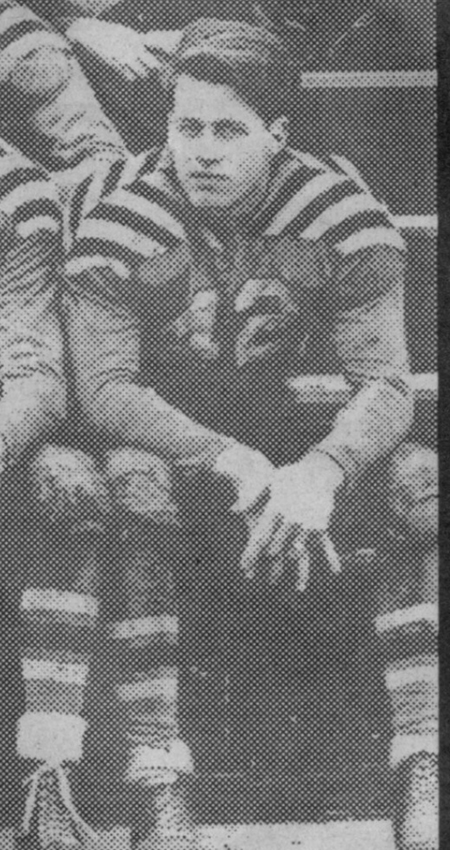
‘Tis the season for football… the Detroit Lions and my Michigan State Spartans are each 5-1 and all of this keeps bringing to mind this shot of my Grandfather, William Eugene Johnson, as a Senior on the 1945 Rockford High School football team which also included my Great Uncle, Louis, and at least a couple of their cousins (Ken Morris and Roger Baker). This shot came to my attention when used in a July 1999 Chalk Talk column by Coach Terry Konkle’s in The Rockford Independent.

I was thrilled to find a new picture book by Caldecott Honor illustrator Lane Smith (It’s a Book) that had a fabulous family history theme just in time for Family History Month. In Grandpa Green, a little boy tells the story of his great grandfather’s life against the backdrop of a topiary garden of memories. The grandson walks through the garden picking up items his grandfather has forgotten while he tells the story of the man born before cell phones and computers who wanted to be a horticulturalist but instead went to war, met his wife in Paris, had lots of kids, grandkids, and one great grandson—the narrator. Each section of text is accompanied by a corresponding illustration of the grandfather’s garden where his memories live on. The detail in the topiary garden is amazing and the story is moving. It’s a well-constructed book with something for children and adults. And it would be a great conversation starter when talking about family history with a child. Recommended for ages 5 and up.

Organized bus trip rule #1: At least 30 minutes before the bus leaves you will find the most fabulous source that you do not have time to get through or photocopy or the person in front of you at the copier will be copying the whole book, or… You get the picture. It’s Murphy’s Law applied to genealogy.

This rule was explained to me by my fellow WMGS members on my first trip to Allen County Public Library’s Genealogy Center in Fort Wayne a few years ago and, in general, it rings true. But I somehow always think that if I plan well enough I won’t get caught. And come Thursday morning, I genuinely thought I had a good enough plan that I wouldn’t have a problem getting finished before the bus left. So, imagine my horror at 2 pm when I realized that the 2 volume source I really wanted to go through would not be doable in the allotted time—I did the math. I had possible family on all but maybe 10 pages in each. I could, of course, copy the entire book but the last vestiges of my time working for a copyright librarian reared its head. So, now I have another set of books on my purchase wish list and at the top of my “To Do List” for the next trip. The impatient part of me wants to order them now in the hopes that they’ll clear up every bit of confusion I have about the Dice/Theis and Koppenhöfer families (not likely…but still).

But it was a relatively successful couple of days. I have a better idea about this particular set of clustered families that moved from Pennsylvania to Ohio and then a smaller batch moved on to Will County, IL. I’m not sure I’ll ever find out why my 3rd Great Grandfather was down in Will County to meet his wife (as opposed to Rockford with the rest of his family) but I feel like I’ve taken a few strong steps to understanding this branch. And the Johnson’s should note that they’re even more German than they originally thought—as the Dice, Koppenhaver, Besore, and (I’m guessing) the Grove families are probably all Palatine Immigrants.

Happy hunting,

Jess

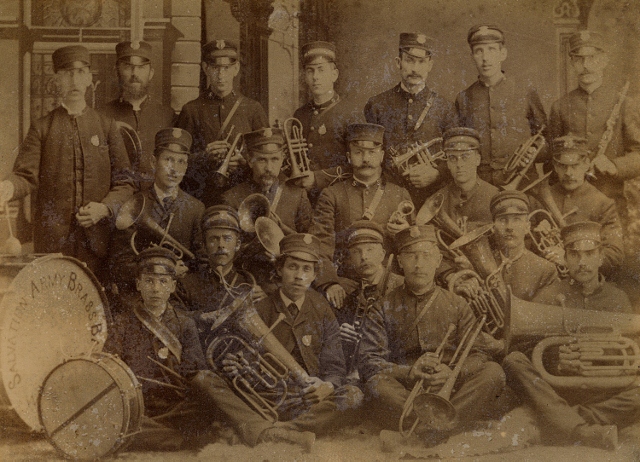
So it took years before I realized that the Salvation Army was a religious denomination… and I’d been driving by a church for years in Lansing, Michigan. The above photograph is from a photo postcard taken by William H. Spinks and currently held by my Great Aunt. It’s the Salvation Army Brass Band of Woodstock, Oxford County, Ontario, Canada. My Great Great Grandfather Cornelius Packer is in the front row, third man in from the left with, what I believe is, a euphonium. The photo was taken sometime between 1881—when the Packers previously identified as Primitive Methodists and 1892 when my Great Grandmother was born in Grand Rapids, Michigan. Just based on his age in this picture and another family shot by the same photographer, I suspect this is mid to late 1880s.

My trip to Allen County Public Library’s Genealogy Center in Fort Wayne, Indiana with members of Western Michigan Genealogical Society has totally snuck up on me. So, I’m taking time out for the next two evenings to prep. For me, that means making a long list of titles and call numbers to have for that first day—generally focusing on two or three branches of the family.

Last trip was spent mostly on the Massy family and while I still want to assemble a list of materials related to them, I am very interested in spending time on some of my other lines. For example, after that interesting session at FGS2011 on Wisconsin research, I’d like to take some time on my Cunningham and Byrne family (my Great Grandpa Robert Shea’s maternal grandparents)—with the eventual plan to add a roadtrip there. And I’ve also been trying to spend a bit of time on the Grove family of Will Co, Illinois, Ohio and Pennsylvania—the line of my 3rd great grandmother who married Smith Lapham’s grandson, Eugene Smith Baker. Then there’s the Morningstars, Helsels, Trotters, Rogers… Did I mention I wanted to limit it to a two or three branches?

So, evidently I’m going in a little unfocused. But I will have options and I will be prepared to start in a section as soon as we arrive, versus spending the first hour working on the catalog. That said, I may totally change my mind on the bus ride to Fort Wayne and go off in a totally different direction—I am one of those contrary women.

Regardless, more than anything, I’m looking forward to relatively uninterrupted time to work on genealogy.

I’ll let you know what I find!

Jess