Great Sources


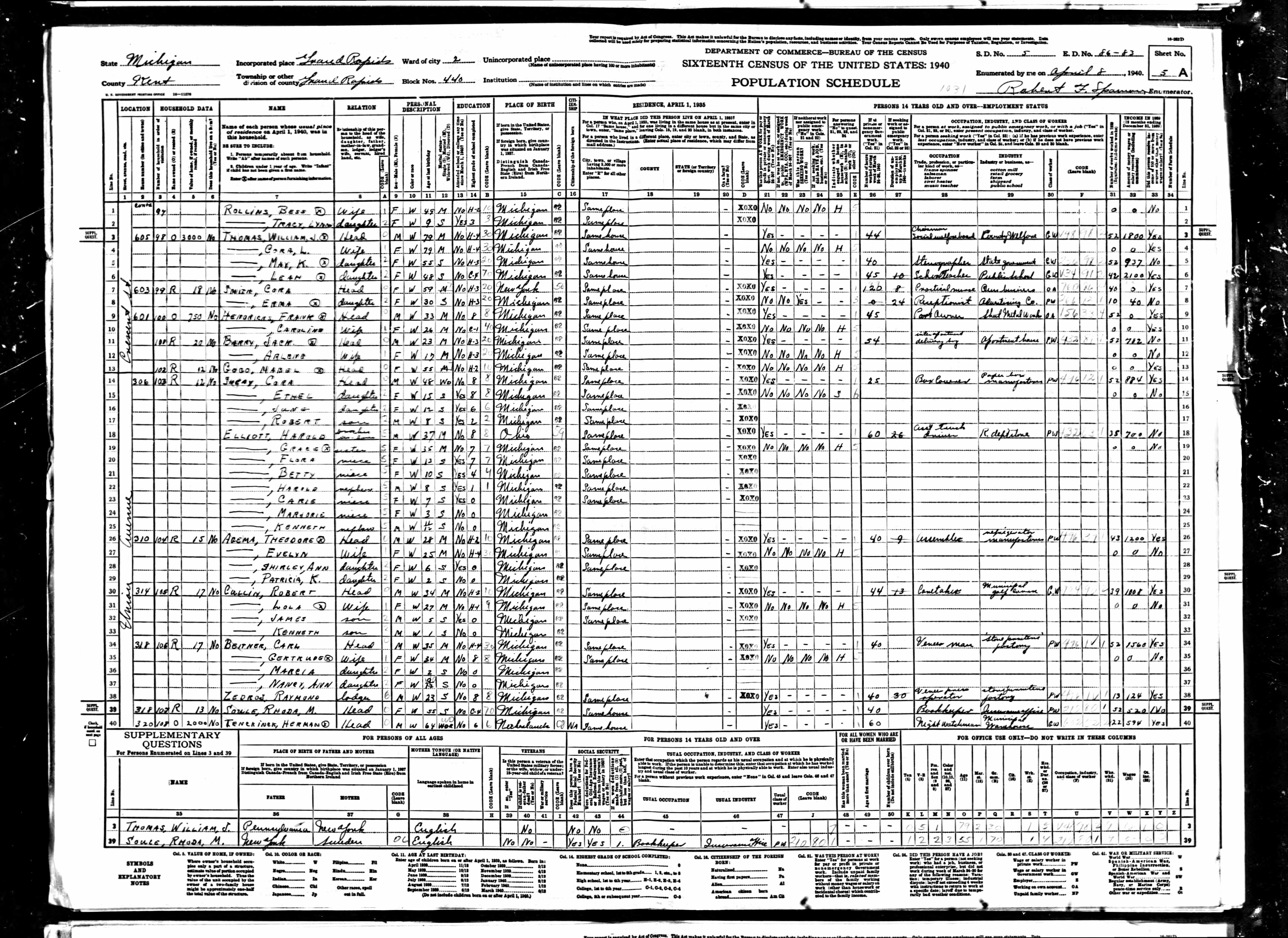
I’ve had lots of long conversations with my Gran and Great Aunt about our families but I have this growing list of questions inspired by research done for these posts and new finds. As an example, I spent hours this week flipping through census pages for Grand Rapids, MI trying to track them down in 1940. I had started with my latest directory locations for the family—which placed them living with my 2nd Great Aunt Pearl in 1937. When I couldn’t find any relatives there I called Gran and she told me they lived on Quimby.  I used Morse and Weintraub’s One Step Enumeration District finder from (http://stevemorse.org) which narrowed the list down to 3 EDs. Then Gran called back and said… maybe it was Union St. Either way she wasn’t sure of the number. So, I entered Union in the finder and it narrowed it down to 30 districts. Needless to say, I found them at 306 Union Street… eventually.

In 1940 Great Grandma Cora was the head of household including my Gran and her siblings and Cora’s youngest sibling Grace (Packer) Elliott and her family—including her husband, Harold, and six of their children. Cora was working at a paper box factory and Harold at an auto plant. I was so thrilled that I posted to Twitter as soon as I found Gran, and almost immediately got a phone call from my mother and Gran because Gran wanted to know what I’d found. It all just leads to more interesting questions: about Cora’s job (which I can’t quite decipher), the moving, all the family they lived with at different times, and really just how Cora managed as a widow with 3 young children.

I think it’s past time for a lunch date with Mom, Gran, and my Aunts!

Happy hunting!

Jess

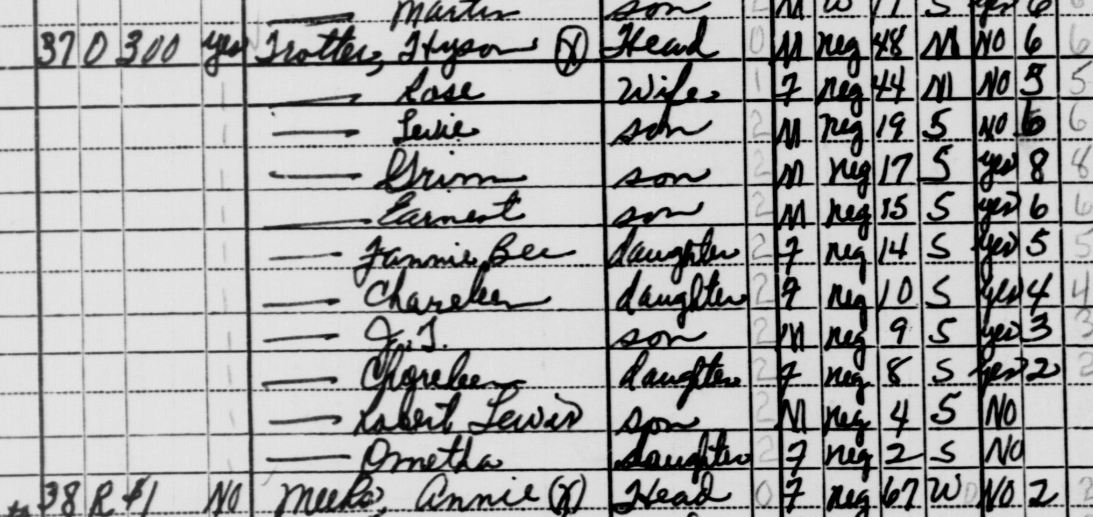
So I haven’t had nearly enough time to work through the Census but I’ve found a few fun bits. I started off searching Bradley County, Arkansas from my Trotter and related families. Palestine township is E. D. 6-7 and 9 pages in I found Papa Monk (Harrison Trotter) and his family and was thrilled to find not only Grandma Rodie on one of the extra question lines confirming she had born 15 children but her daughter, my aunt Irene, on the other one. Harrison and Rhoda are actually listed as what looks like “Hysom” and “Rose” but from then on it’s my Grandpa and his siblings—definitely the right family.  I have so much family in Bradley Co. That I’ve barely begun, but I wanted to find them first. I suspect without indexing finding Gran will take longer—I believe she was living with family in town by 1940. But I’m hoping to have time to go searching for her soon.

On the other side of the family, I’ve now gone through a good chunk of the 4 townships surrounding Rockford for and I’m now working on Rockford proper (I also have to do Plainfield still). I have located my (Great) Grandpa Bailey as the head of my grandpa’s household in Rockford. But I haven’t yet found my biological Great Grandfather Robert or his family. I don’t know where to start from Gran yet but I think I can get a street address and narrow down the search in Grand Rapids. I just haven’t put any time into it yet.

But I’ve got so much to do still… just need to grab more time for research!

Happy Hunting,

Jessica

In the process of looking for information to fill out a future blog entry, I happened upon the Michigan Pioneer and Historical Collections. It is a collection that I had heard of and I’d seen things transcribed from, but I’d never had the opportunity to use it. And with a portion of my family solidly planted in the Michigan Territory prior to the 1830s, this is a source I had planned to check out. So I was thrilled to find an MSU Libraries Research Guide that linked to the Hathi Trust Digital Library’s catalog entry for the digitized volumes.

The collection takes some searching. It consists of three distinct series of varying quality from reminiscences to solid historical research largely covering a span from 1650-1850. Also digitized are two indexes covering about 30 of the 40 volumes; but the rest are individually searchable. I spent way too much time just searching various family names. I hit solidly on my Lapham and Gilbert connections and their allied lines, finding a mix of anecdotal and more trustworthy notes. If you’ve got Michigan pioneer ancestors this is worth checking out and infinitely easier now that it’s digitized.

Happy hunting,

Jess

I’ve managed to sneak over to the Library of Michigan a few times in the last couple weeks with the hopes of checking my oldest research and sources. I actually did a bit of a double take when I realized how long I’ve been working on some of my families and how haphazardly I cited when I started. Please believe I have improved dramatically!

That said, I forget sometimes—as it’s in my own backyard—just how fabulous the Genealogy Collection is at LOM. The microform, book, and newspaper collections kept me going for years before I ever travelled to another institution. This past week I worked with a 2 volume, fabulously footnoted, genealogy of the Holden family and a couple of county histories from New York. Next week will probably be a couple of different New York Counties and looking for Kent County obituaries. And I know that there are hundreds of relatives still tucked away in the collection for me to find.

All politics aside—and there has been a lot surrounding the Library in the last 3 or 4 years as the State tried to decide what it would fund—it’s still a notable collection for researchers in general, and Michigan families in particular. If you haven’t already, check it out.

Happy Hunting,

Jess

Letters have been on my mind lately. My Gran recently loaned me a packet of letters to go through. They were a mix—a couple from her to my late Grandfather, a few from Grandpa to her, and a number of letters from her children—including one from my Mother to Gran that was so remarkably close to one I wrote Mom when I was away for a summer (and recently read from Mom’s Archive). Letters can offer such interesting insight into a person’s character, the times, and the trials of those discussed. Some of my favorite lines in this stack include:

From Grandpa stationed in San Francisco, CA in to my Gran back in the Michigan: “I hope you are not being bothered too much by my going away present.” (i. e. my Mother)

From Gran visiting my Uncle’s family while he was stationed in Germany to my Grandpa in Michigan: “Sandy hasn’t had a letter from her mother yet and we would really like some mail—Tell Lorraine to get on the ball!” And in close, “P.S. Did you water my plants?”

From my Mom to Gran: In a list of reminders… 2) Put my doll up, out of Vicky’s friend’s reach… please!! Not that I don’t trust them or anything… but!

Letters are also on my mind because I started following Letters of Note after Cory Doctorow at Boing Boing made my day by linking to a really interesting letter from a former Slave to his former Master. Check it out and be sure to read to the end!

Happy Hunting,

Jess

I did make it out to Howell this past week—despite cough and winter weather advisories—to check out the Howell Carnegie District Library and more specifically visit its Archives. I had a great time going through boxes of materials on the Michigan State Sanatorium which gave me even more insight into that institution. And some wonderfully illustrative material which I think will bring it to life better for my relatives.

I also noted earlier that my 4th Great Grandfather was listed in one of the online indexes for the Archives. He was listed because they have indexed all Livingston County Civil War Veterans and Henry R. Massy was a replacement soldier for a Hartland, Michigan draftee. So I didn’t really find new information there but it gave me the chance to better study the information offered in the regimental histories created by the state of Michigan.

The volunteers were fabulously helpful gentleman with interesting stories about the more recent history of the hospital (before it was demolished) and about fellow researchers. And the collection looks like it could be a gold mine for researchers with Livingston County roots. Also, the building itself is lovely, with an ornate Carnegie façade, and an unobtrusive modern addition off the back including space for the fiction and non-fiction collections on one floor and an enviable children’s and teen area on the lower floor.

It was definitely a worthwhile road trip!

Happy Hunting,

Jess

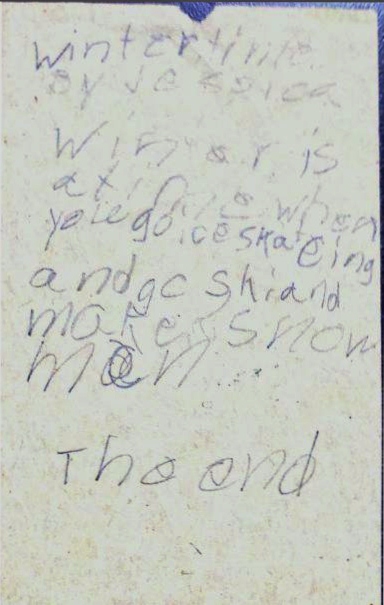
The blog and our conversations inspired my mother to pull out a fabulous stack of mementos and keepsakes that she’s had stashed away and added to over the years (which I almost dumped a glass of wine on—Yes, me and my archival degree). Among the finds were a stack of stories and poetry I wrote as a child, some as loose sheets and others assembled into booklets. My father and I exclaimed over one of the booklets because in the back I had added a photo album to illustrate the personal stories it included four fabulous and well preserved photographs. There was also a booklet of my maternal grandfather’s poetry and poetry he had collected, a TWA certificate from 1956 stating that my mother had completed the flight from Paris to Detroit, and a good size stack of Mother’s Day cards from my brother and I to Mom. It was fun to go through the packets and really interesting to discuss what I found with my parents. The picture is a sample find from my childhood.

Translation:

Wintertime by Jessica

Winter is a time when you go ice skating and go ski and make snow men. The End.

It made me laugh for a number of reasons including the idea that I associated these things with winter but I didn’t learn to skate or ski until my freshman year of college.

Look for your family stashes!

Happy Hunting,

Jess

I’m somewhat winding down on my research on the Michigan State Sanatorium and it’s Follow Friday—both of which bring to mind the Look blog article which I had saved in my email (for almost two years) entitled “A Healing Place.” I don’t think I would have thought to search the archives for information on my great grandparents’ time at MSS if not for this article (even though I let it sit forever). And between Look and the rest of the amazing collections on SeekingMichigan.org I would heartily suggest you follow them—if you have any interest in Michigan history or genealogy.

Happy Hunting,

Jess

Here’s my first follow-up post from research inspired by sessions from the Michigan Genealogical Council’s 2011 Family History Month Workshop.

As I noted in an earlier post, Pamela J. Cooper’s Homestead Act session encouraged me try requesting a selection of the Federal Land Entry files for my ancestors.  On October 30th I started out by ordering the file of Levi Hampton who was listed in the 1900 Census as my Great Grandfather’s uncle and is one of the few members of my Arkansas family to have a patent listed in the BLM database 

I searched the BLM database for Levi Hampton in Bradley County, Arkansas (one can further limit a search under the “Miscellaneous” section switching the drop down menu beside “Authority” to “Homestead Entry Original”). I took the information in that entry to fill out the NARA order form. The request is currently $40—but it should be noted that this is a flat fee regardless of the size of the file. The deliverables can be photocopies or a digital copy.  I ended up requesting a digital copy to save myself the time scanning.

I was thrilled to receive the disk within 11 days—which is a little funny because it still shows on my NARA account as waiting to be sent. Levi’s file is 44 pages and includes his testimony, as well as that of two distant relatives—Wil Newton and Wilson Terry. I will admit that I really got my hopes up because Levi initially named my 3rd great-grandfather Sam Trotter, his brother, Rial, and their stepfather James Newton all as witnesses. But when the time came for the hearing Newton and Terry were the only witnesses. But regardless, there is a lot of information that I can cull from the file and I’m looking forward to spending more time on it.

Maybe the most interesting moment for me in reading the file was when I got to the presiding Judge, W. J. Hickman’s note on the change of witnesses. He comments, “I think myself that this witness is as good as either one of the others as he has been raised in the neighborhood of the said claimant. They are all Colored and one is as good as the other not withstanding his name does not appear in the publication.” I’m not sure why but it momentarily took my breath away to see that stated so plainly in a federal document. But as my parents noted when I shared it with them… it was a different time.

These files are definitely worth the price and slowly but surely I’ll start ordering Shea, Cunningham, Wilfong, and other family files.

Happy Hunting,

Jess

This week’s research included a pair of trips to the State Archives of Michigan to look at the patient records of my Great grandparents, Cora Packer and Robert Shea from the Michigan State Sanatorium (MSS) in Howell, Michigan where, according to family story, they met as Tubercular patients.

Now, this is a set of restricted records accessible by patient or by researcher with death certificate of patient in hand. Additionally, the records are not totally indexed and are in order by case file (roughly admission date). And, going in, I was only certain that my Great-grandfather was a patient during the 1920 Census and that my Great-grandmother was a patient sometime.

The Archives staff, on first pass, was only able to find my Great Grandmother as a patient—for a grand total of nine months in 1916—four years prior to when I knew Robert was there. But they couldn’t find Robert in the index. Luckily, the staff was very helpful. They checked 1916 on the theory that Cora and Robert met during her time at MSS, and then 1919 and 1920 based on what I told them about the 1920 Census and my pictures of Robert at the facility. When none of that worked they graciously consented to check 1917 and 1918 and let me know if they found anything. Within a couple of days they had gotten back to me—they had found Robert. He had been admitted in late 1918 and discharged in 1920.

So, what did I find out? I’m still working through my copies of the files but for all MSS patients there should be a detailed set of forms filled in on entry to the facility which included a family health history section. It asked questions such as occupation, name of a close relative, and it requested information about grandparents, parents, and siblings. For Robert, in particular this was interesting because the facts might not support my theory about the identity of Robert’s grandparents. But with Cora it also noted that one living and one deceased sister were also diagnosed with TB.

This set of forms also has updates on dismissal from MSS. So it corroborated the story that Robert had had some kind of surgery for his TB. Interestingly enough, he had an operation called pneumothorax in which they temporarily collapsed some portion of his lung allowing it to rest and hopefully prevent TB lesions from spreading to healthy lung tissue. If Robert had a lobectomy, as his daughters were told, it wasn’t during his time at MSS.

The files also each had at least one other bit of treasure. For Cora the standout item was a handwritten letter sent to MSS advising them of her arrival when she was accepted into the Sanatorium. For Robert, it was a detailed letter about his movements from the time he was dismissed from military service due to his health to the time he was accepted at the Sanatorium—for insurance purposes. It included a list of jobs he attempted, but was too weak for, such as working in a basket factory in Traverse City, Michigan and cutting wood for the Antrim Iron Company in Mancelona, Michigan.

If you have a tubercular patient from this period it’s worth trying to track down the patient files. The information in them is fascinating.

Happy hunting,

Jess

Note: I also just finished, A History of the Michigan State Sanatorium and An Evaluation of It’s Role in the Anti-Tuberculosis Campaign by Marjorie D. Parsall (1991). This is a fascinating Masters of Arts thesis for Oakland University available at the Kresge Library at Oakland. It was very useful to have gone through this ahead of looking at the patient records because it gave me a better idea of what medical practices were for the time in which my Grandparents were at MSS.
« Previous PageNext Page »